PARTICIPATE, DON'T BUILD
Leon Krug, Peter Jüssen, Yann Englen - Bachelor Thesis - Alanus University, 2023/24
Nominated for: BDA Masters Award - Best Bachelor Thesis in Architecture
SYNOPSIS: Our bachelor thesis began with a seemingly simple question: what should we do with vacant large-scale properties?
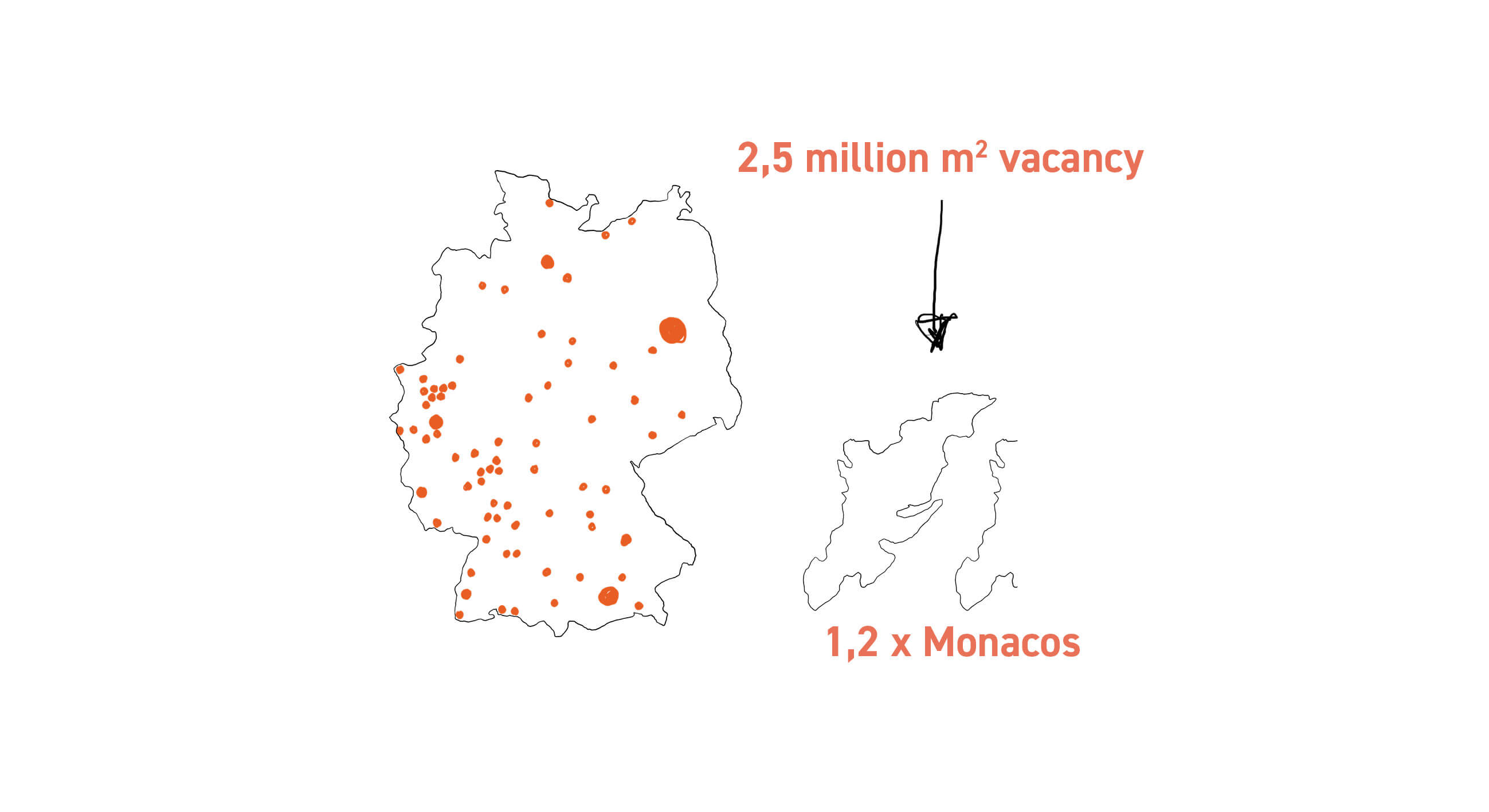
Following the insolvency of Galeria Karstadt Kaufhof, Germany's largest department store chain, more than 2.5 million m² of retail space fell vacant, an area equivalent to 1.2 times the size of Monaco. Working through literature, scientific papers, and conversations with experts, politicians, and local communities, we arrived at two figures that closed off the obvious answers. The embodied CO₂ in an average department store is equivalent to roughly 900 years of non-stop driving, which rules out demolition. And finding a new tenant for a building of this size typically takes eight to ten years, which rules out waiting.
Out of that dilemma came a deceptively simple proposal: continue using the building. To make that possible, we developed a set of tools built on two concepts, dynamic usage and participatory design, the second of which puts citizens in front of a 1:24 model where they plan the building's future with Playmobil figures. Neither requires structural change to the building.
THE CHALLENGE: The insolvency of Galeria Karstadt Kaufhof has had a profound impact on cities across Germany. In a short period, over 100 department stores closed, leaving more than 2.5 million m² of retail space vacant.
We focused on the former Kaufhof in Siegburg, which is representative in both size and structure of many department stores from the same era. To understand what such a building means for a mid-sized city, it helps to know that it accounted for 25% of Siegburg's total retail space. With its closure, foot traffic through the centre is likely to decline, which in turn affects the businesses around it. Finding a new purpose for the building is not only a question about the building.
None of the standard responses to vacancy are quick or sustainable. Demolishing and rebuilding carries high costs, long construction times, and significant embodied CO₂. Finding a new tenant at this scale takes eight to ten years, during which the building sits empty and the surrounding centre continues to decline. A different approach is needed, one that can reactivate the building quickly and without waiting for certainty about its long-term future.
THE CONCEPT: The proposal is to continue using the existing, functional building, and it rests on two ideas: dynamic usage and participatory design. Around each, we developed a set of tools and strategies to make implementation practical rather than theoretical. Together they allow the building to be revitalised in an adaptable way, and to remain an active part of the community while its long-term future is still being worked out.
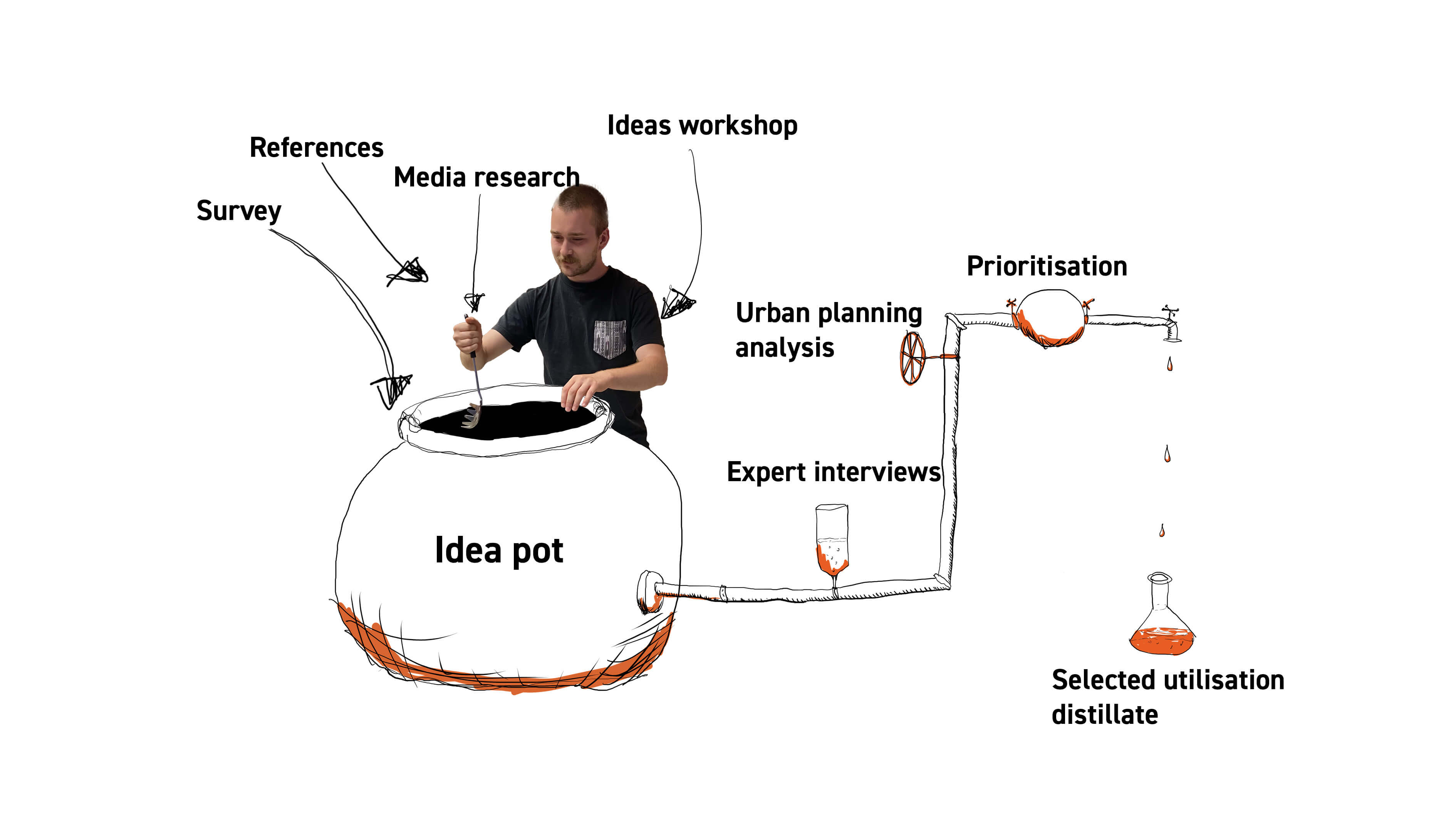
DYNAMIC USAGE: Dynamic usage offers a flexible, open-ended approach to reactivating vacant buildings like the Kaufhof Siegburg. Unlike conventional interim use, which is defined by a fixed end date, dynamic usage leaves open how long any given project stays.
Rather than deciding far in advance what the building's permanent use will be, different users occupy the space and experiment to find out what works. Ideas can be tested without long-term commitment, which keeps the building active while the answer emerges. Uses are developed through a structured pipeline, so the transition from one project to the next stays seamless and responsive. A number of stable anchor tenants provide financial reliability, creating room for smaller projects that can adapt, expand, or end.
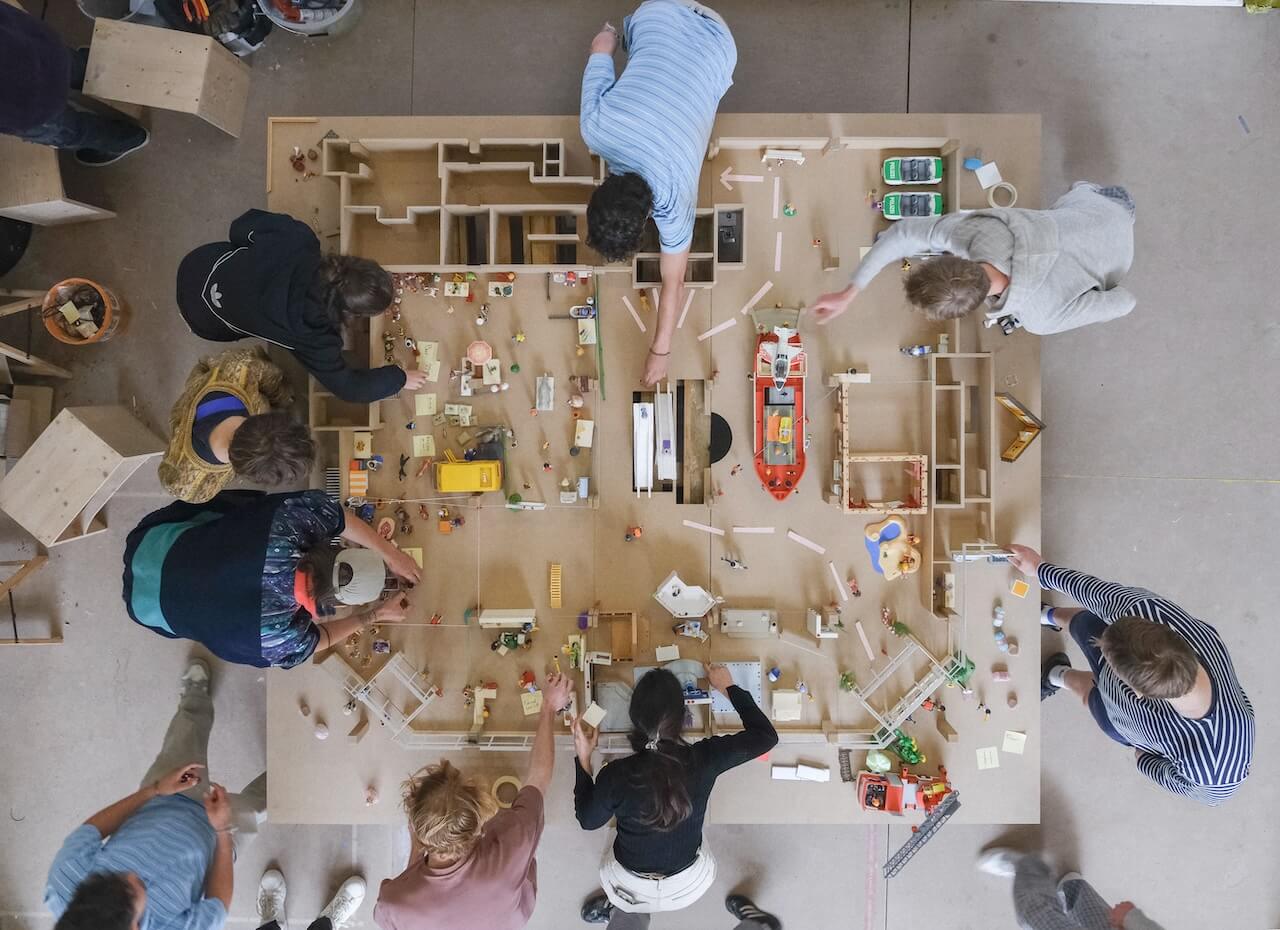
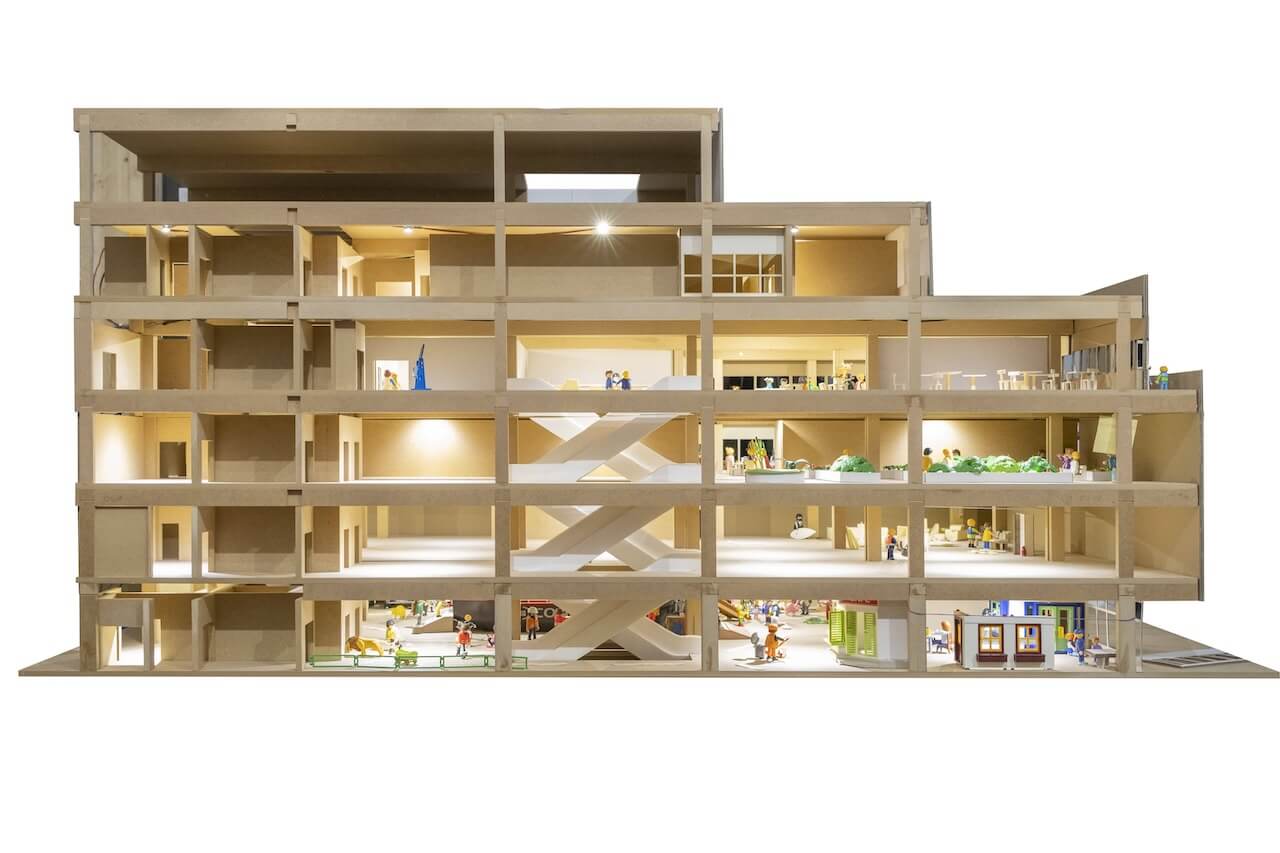
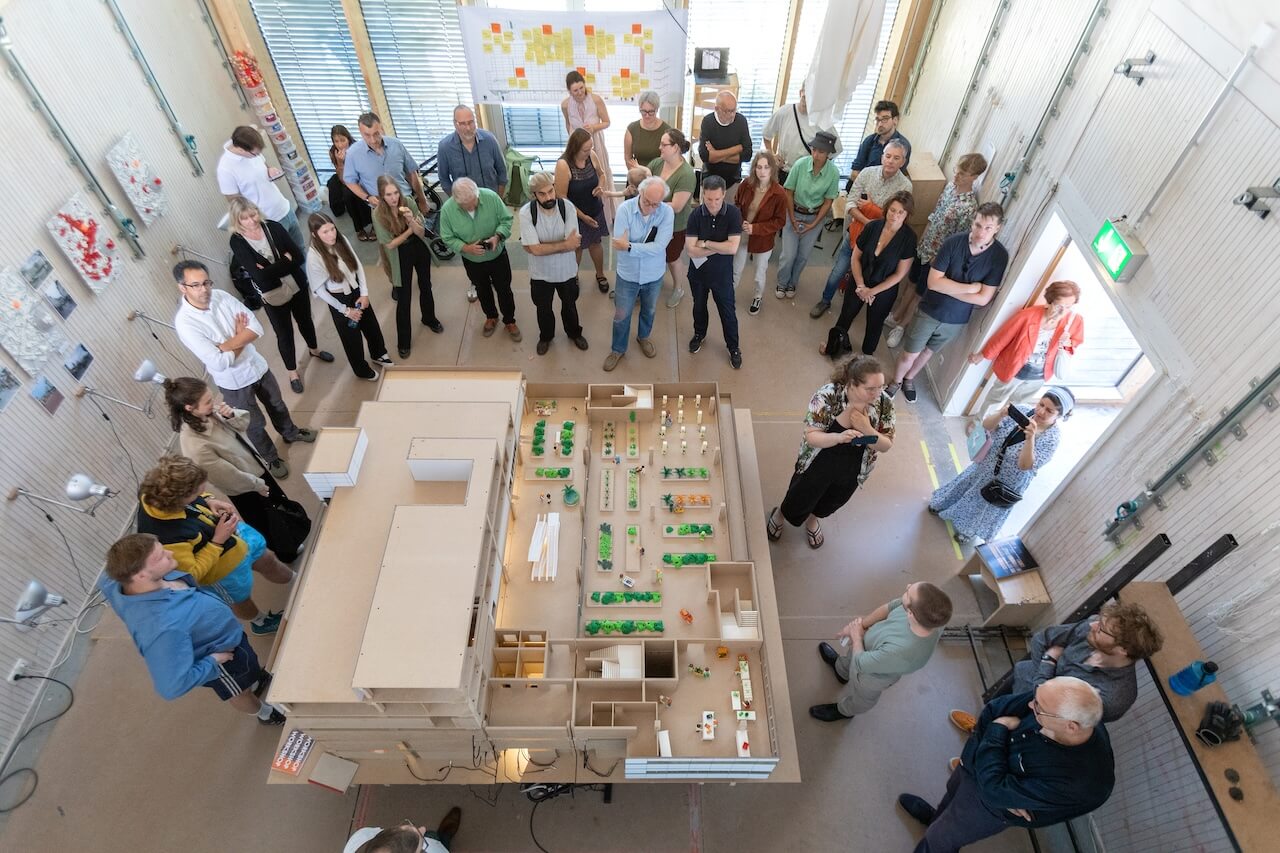
THE MODEL: The model makes participatory design accessible. Using Playmobil figures at 1:24 scale, residents can contribute to the design process regardless of whether they have any architectural training. The model is tangible and immediately legible, which turns speculation into something people can arrange with their hands.
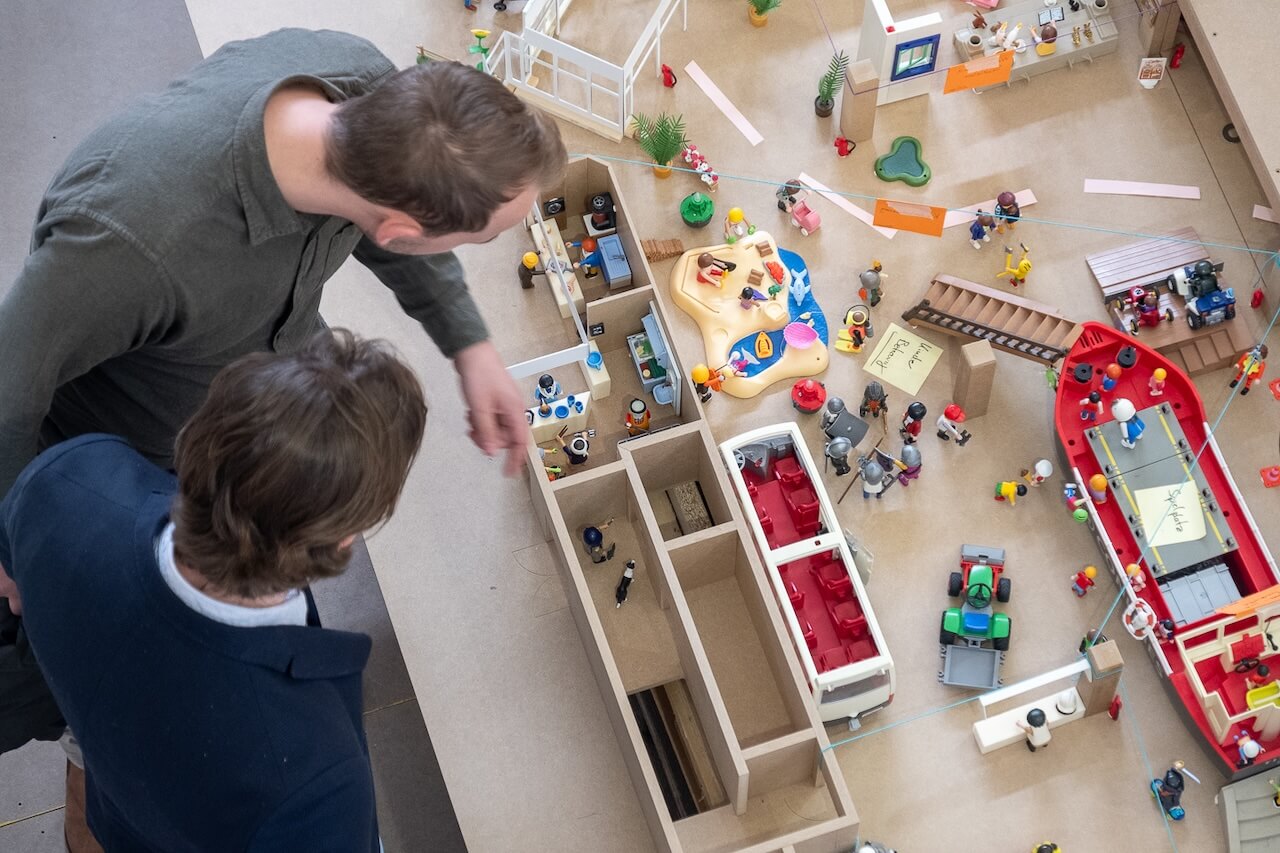
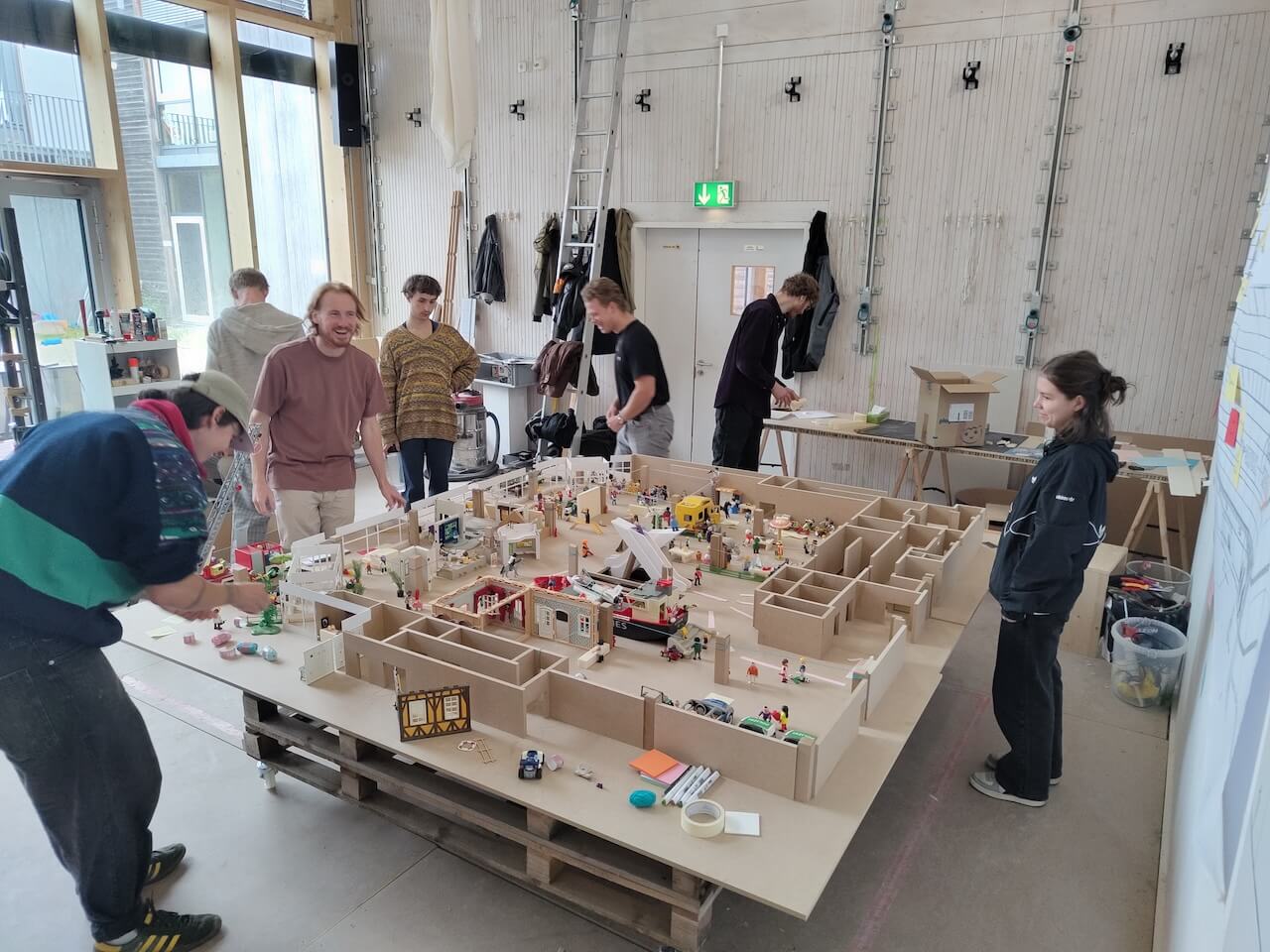
That accessibility is the point. It lowers the barrier to participation and establishes a direct connection between an idea and its actual spatial consequence. Realistic, workable usage concepts emerge from people who use the town centre every day. These inputs are then translated into architectural proposals for the upper floors, demonstrating how participation can shape a building's future rather than merely comment on it.

CONCLUSION: Siegburg is one building in one mid-sized town, but the condition it represents is not unusual. Over a hundred department stores closed within the same period, most of them structurally similar, most of them anchoring town centres built around them.
What this thesis proposes is not a design for a single site. It is a method: keep the building in use, let its programme be discovered rather than predicted, and involve the people who live around it in working out what it should become. The tools are deliberately low-threshold, because the alternative to acting quickly is not acting carefully. It is a decade of vacancy while the centre around the building empties out.
The most sustainable building is the one already standing, and the fastest way to keep it standing is to keep it in use.
ZUSAMMENFASSUNG: Mit der Insolvenz von Galeria Karstadt Kaufhof stehen in Deutschland über 2,5 Millionen m² Einzelhandelsfläche leer, das entspricht der 1,2-fachen Fläche Monacos. Unsere Bachelorarbeit untersucht am Beispiel des ehemaligen Kaufhofs in Siegburg, wie sich solche Großimmobilien schnell und nachhaltig weiternutzen lassen.
Abriss scheidet aus: Die graue Energie eines durchschnittlichen Kaufhauses entspricht rund 900 Jahren ununterbrochenen Autofahrens. Die Suche nach einem neuen Ankermieter dauert bei dieser Gebäudegröße in der Regel acht bis zehn Jahre. Beide Wege lassen das Gebäude zu lange ungenutzt, während das Zentrum um es herum an Frequenz verliert.
Der Vorschlag ist bewusst einfach: das bestehende, funktionsfähige Gebäude weiternutzen. Grundlage sind zwei Konzepte. Die dynamische Nutzung lässt wechselnde Projekte ohne festes Enddatum einziehen, sodass sich die künftige Nutzung im Betrieb herausbildet, statt vorab festgelegt zu werden. Die partizipative Planung erfolgt über ein Modell im Maßstab 1:24, in dem Bürgerinnen und Bürger mit Playmobil-Figuren eigene Nutzungsideen entwickeln und räumlich durchspielen.
Die Arbeit wurde für den BDA Masters Award als beste Bachelorarbeit im Fach Architektur nominiert.
Press/Media
ARD/WDR - television feature, December 2024
General-Anzeiger - Playmobil model shows possible future uses for Kaufhof Siegburg
Kölner Stadt-Anzeiger - architectural model for Siegburg